A new air base in cambridge
For the last 19 years, we have worked with the owners of Cambridge Airport, Marshall, to ensure that our helicopter, critical care car and crew can swiftly attend critical care emergencies across the region, and we are incredibly grateful to Marshall for their support during this time.
However, with the planned closure of the airport, we must urgently relocate and build a new base for our Cambridge-based operation to be able to continue providing our vital service to the people of Bedfordshire, Cambridgeshire, Norfolk and Suffolk.
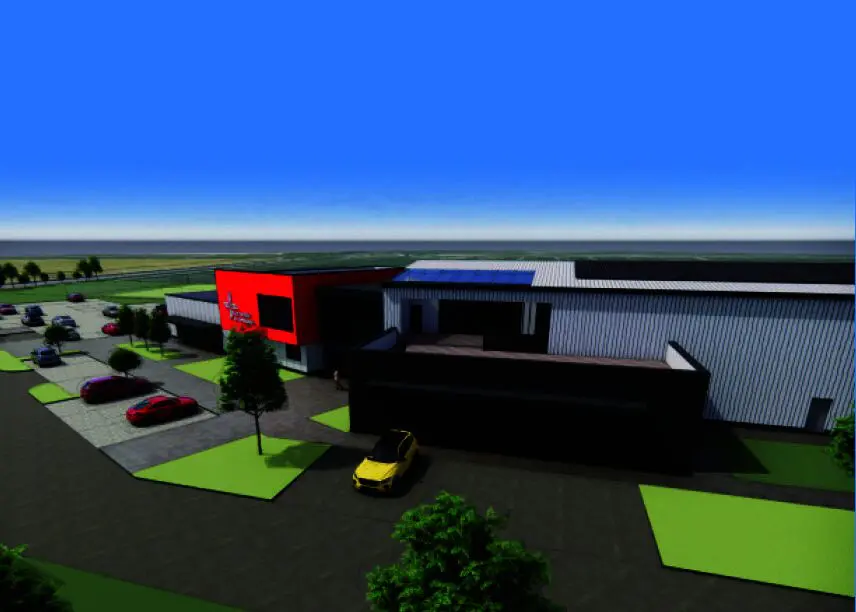
The need for two strategically located operating bases
East Anglian Air Ambulance exists to provide pre-hospital critical care for people affected by sudden medical emergencies and traumatic injuries in Bedfordshire, Cambridgeshire, Norfolk, Suffolk, and beyond. Much more than just a fast ambulance, our crews bring the A&E unit directly to the scene of the incident to deliver lifesaving interventions when they are needed most.
But today, this essential service is at risk.
East Anglian Air Ambulance serves an area roughly two-thirds the size of Wales with a population of almost 3.2 million people – any one of whom could suddenly find themselves or their loved ones in a life-threatening situation. This requires two strategically located operating bases at Norwich and Cambridge to ensure our crews can respond rapidly by air and by road wherever and whenever disaster strikes.
These bases make our work possible. However, the planned closure of Cambridge Airport – current site of our Cambridge operating base – casts this vital service into jeopardy. We have acted swiftly to locate a viable alternative site, but we need your help to purchase the land and construct a new and improved home for this lifesaving service.
As a 24/7 emergency medical charity, we work around the clock to be there for anyone who needs us.
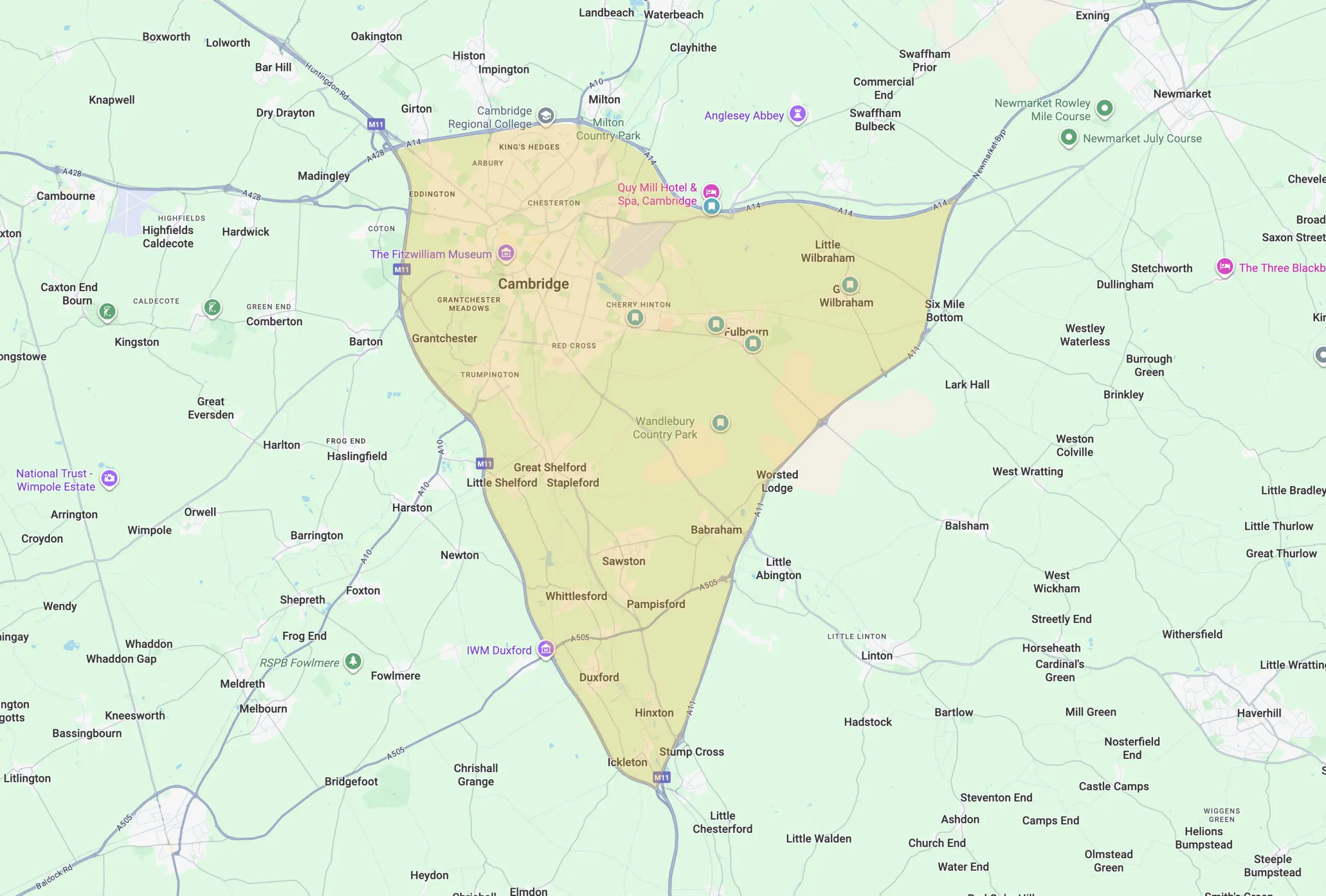
The search
Following a thorough regional review of patient needs, existing critical care and helicopter emergency medical service resources, our operations team concluded that Cambridgeshire remains the optimal location for our operation, specifically the area immediately surrounding Cambridge. After reviewing dozens of sites, the team were able to shortlist 22 candidate sites in and around the triangle of major roads surrounding the city, including some of the region’s existing airfields. The list was then narrowed down based on operational considerations such as drive and fly population coverage, aviation compatibility, land availability, land costs, and existing infrastructure on the site.
Following this extensive research and assessment, land at Shardelowes Farm on Balsham Road in Fulbourn was identified as the only viable option available to the charity. The site is located 2km southeast of Fulbourn village and extends to approximately 10.35 acres.
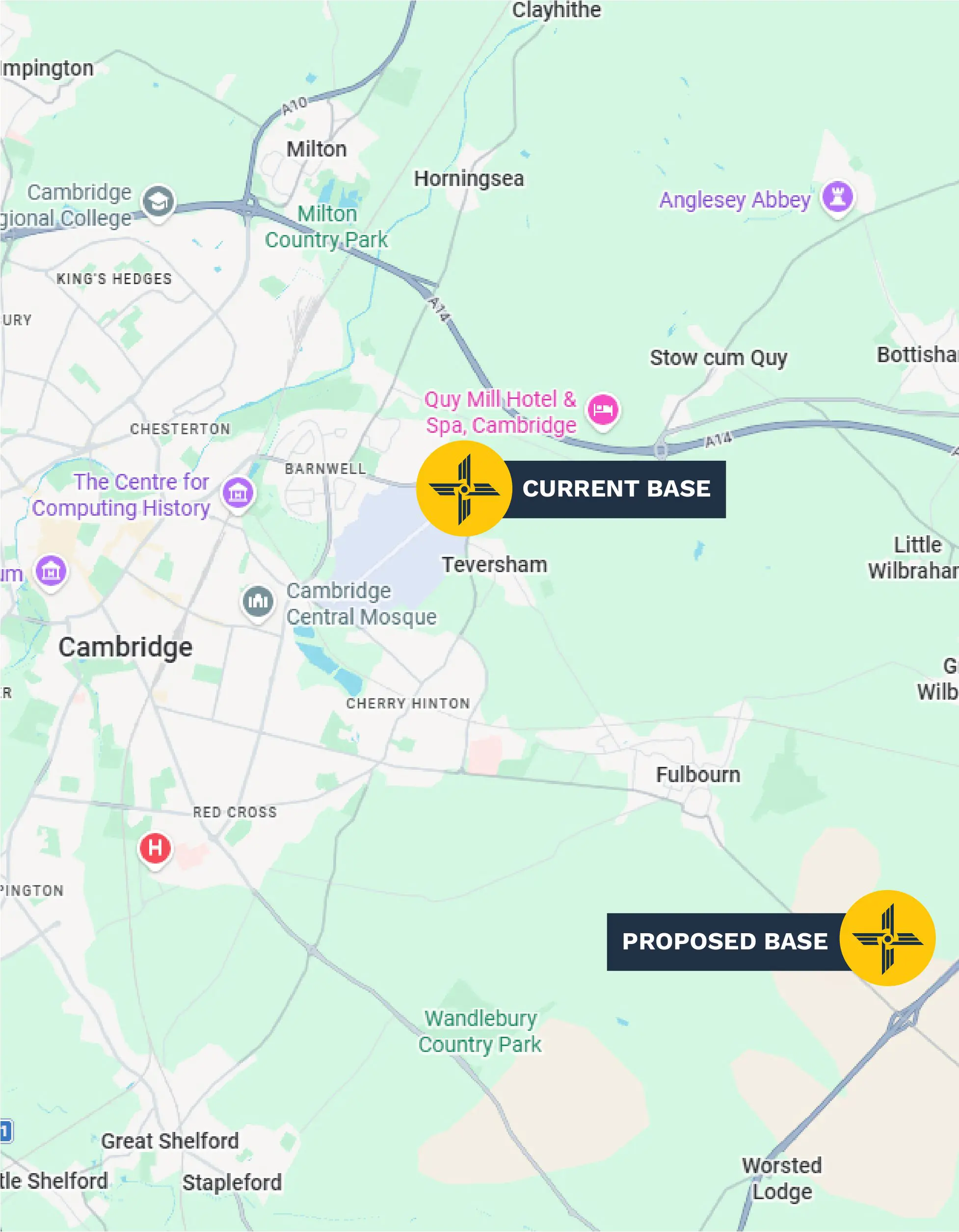
The site
Strategically located within 700 metres of the A11, the major arterial road provides rapid access to the south, north and east. Additionally, Balsham Road offers direct connectivity to Cambridge. Response times are comparable to our current Cambridge base in terms of drive and flight times and associated population coverage. A ten-minute flight time from this location can reach a population of 1,206,000 and a 20-minute drive time can reach a population of 276,000.
The site has been audited by Babcock, our aviation partner, and is highly compatible with aviation. For the Airbus H145 D3 helicopter, which we operate, the site can accommodate a Final Approach and Take-Off area (FATO) which allows us to perform a class one clear area departure, enabling safer flying. It’s also been assessed as being highly compatible with Point-in-Space (PinS) approach, which would allow us to utilise GPS-based navigation for precise landing and take-off in challenging weather conditions.
The ten acre site will let us build a new base to the specification we need, futureproof and safeguard our operation, ensuring we have the facilities needed now, and in the future. We’re not planning immediate expansion, and our priority remains delivering our existing Cambridge service (7am–7pm by air, 7pm–7am by road), but we always look for ways to best serve our community. Flying 24/7 from Cambridge isn’t an immediate plan, but we’ll ensure the base can support it if needed. Any future change would depend on clear evidence of need and the resources and funding to sustain it long term.
The future of your lifesaving service
The base plans have been designed with a clear purpose: to enable our crews to respond quickly, by air and road, to take lifesaving skills and treatment directly to people in our region when the unthinkable happens.
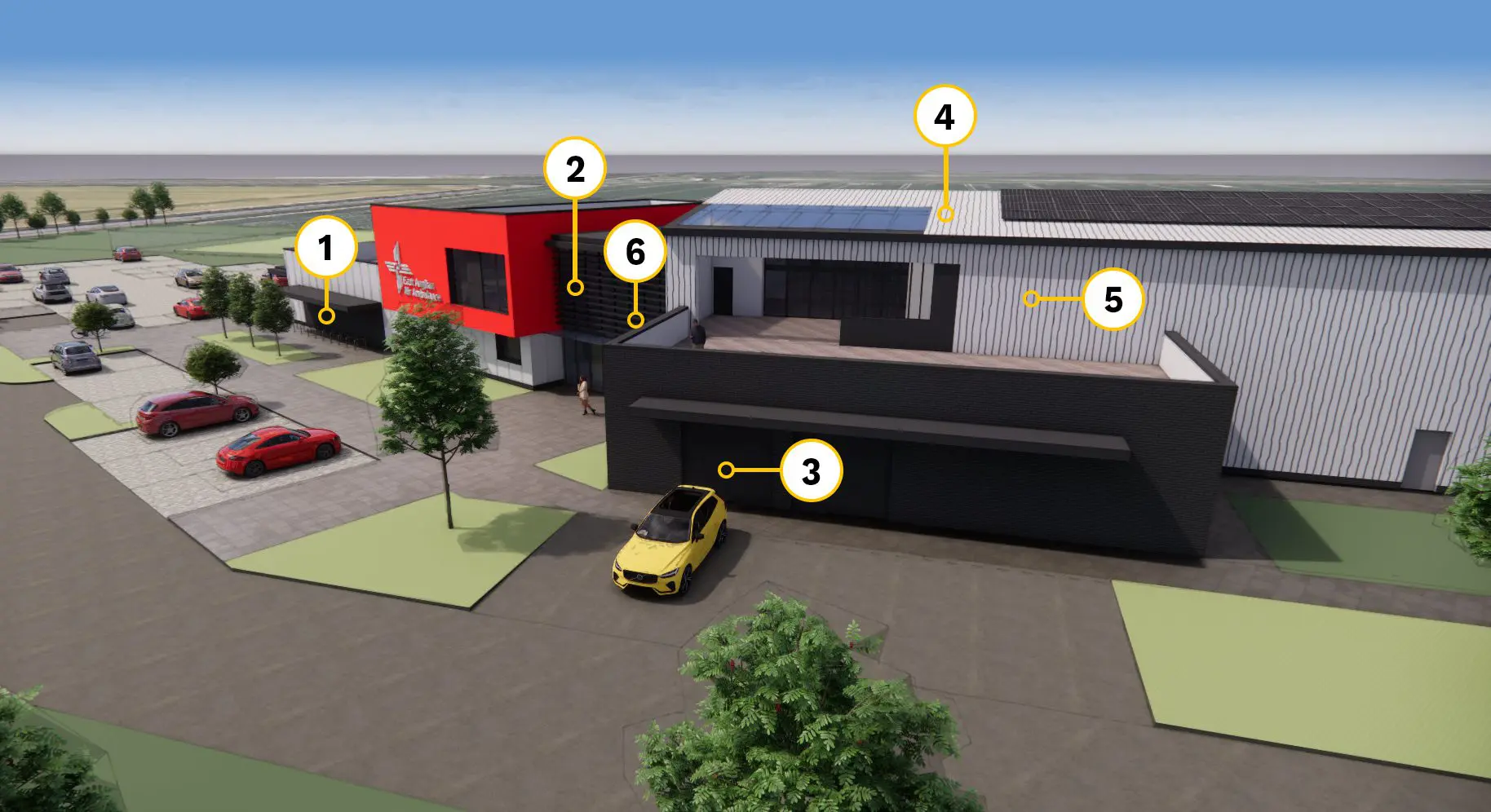

community hub
An exciting part of the new base plans is having space for our fundraising teams to work alongside our operations team, as well as opening our doors and connecting with the incredible supporters, fundraisers, and volunteers who make our work possible.

Space for aftercare support
Areas for former patients and their families to receive aftercare support in the aftermath of a life-changing medical emergency. There will also be space for ground staff to ensure we can run safely, efficiently and compliantly.

Garage
Space for two critical care cars so we can attend people by road. The critical care cars give us an alternative way to take hospital-level care straight to the patient, as it's sometimes faster to go by road.

Hangar
The new hangar will be able to accommodate two helicopters. While we will only have one helicopter based in Cambridge, the bigger space provides a controlled environment for aircraft maintenance, inspections and aircraft swaps, saving us time and money.

Crew facilities
Duty crew office, medical store, lockers, showers and spaces dedicated to crew rest and welfare – all essential to deliver a 24/7 lifesaving service.

Training facilities
We'll create a centre of clinical excellence with dedicated spaces for continual crew and emergency services training, and offer opportunities for the public to learn vital CPR skills.
Frequently Asked Questions
The speed of EAAA’s aircraft means any difference in response time by air will be negligible. While it is true that the new site is further from central Cambridge by car, we will no longer be on an active airfield and therefore we will not have the delays associated with getting through security and driving airside at Cambridge City Airport. Taking this into account, EAAA’s operations team has concluded that response times by car are comparable to our current operation in Cambridge.
It is important to note completion of purchase is subject to successfully obtaining planning permission for our proposed development and use. We currently estimate that planning permission will be obtained around July to October 2026, at which point the agreement becomes legally binding. Under this timeline, and subject to successful fundraising, we are still on track to begin construction towards the end of 2026/early 2027 and will work toward a deadline of being operational in the new air base by December 2027.
During Cambridge airport opening hours (which are working hours, Monday-Friday), EAAA does benefit from Air Traffic Control, which aids deconfliction with other air traffic and provides the Instrument Landing System (ILS) on the runway, allowing EAAA to fly in poor weather conditions.
With the proposed site not based at an airfield, the charity will no longer benefit from the ILS, however, we are exploring an alternative system called the Point in Space (PinS) system, which will allow us to utilise GPS-based navigation for precise landing and take-off in challenging weather conditions.
The hangar at Helimed House was constructed to be large enough to house two helicopters. This was done for both logistical reasons (it makes aircraft swaps much easier, such as when one of our helicopters is going off for routine maintenance) and for future-proofing. However, 2PinS procedures are specialised helicopter protocols that utilise GPS-based navigation for precise landing and take off. These procedures enable helicopters to be accurately positioned at specified points, effectively avoiding obstacles and ensuring safety in challenging conditions. However, while we can accommodate both of our current aircraft within the hangar at Helimed House, there are other considerations that would rule out running both operations from Norwich Airport.
Firstly, tasking times for large parts of the area we cover would be drastically increased. Local people in Bedfordshire, the western part of Cambridgeshire, and the south of Suffolk would have to wait a lot longer for our teams to arrive by helicopter. For example, the response time to Luton from Norwich Airport would be almost three times longer than from the current air base in Cambridge.
Secondly, response by car would be virtually non-existent for patients outside of Norfolk. We currently only respond to emergencies by critical care car at night (7pm – 7am) and at present around 45% of the patients we attend from Cambridge City Airport are reached by car, often because these patients are in urban areas where it will be difficult if not impossible to find close enough sites to land a helicopter. Without a local air base in Cambridge with rapid access to major road networks, it would not be possible to reach these patients in good time.
EAAA is putting in place a range of mitigation measures to minimise disturbance to the site’s neighbours, including conducting noise surveys and establishing designated flight routes to minimise the impact on housing.
A report has been created by capturing the sound of the G-HEMC aircraft carrying out manoeuvres and approaches at Cambridge airport and benchmarking this against the ambient noise at the site. Using the results, EAAA’s aviation team have created flight plans that will minimise the impact of noise on local residents, particularly in the hours of darkness.
The initial findings have shown that noise from the helicopter falls below statutory limits in the day.
The charity will initially be operational 7am – 7pm by air and 7pm – 7am by road and the findings have shown that noise from the helicopter falls below statutory limits in the day, and below statutory limits for all but one house at night.
The existing buildings on the site and the similar adjacent buildings have a very similar profile to our proposed plans and would in fact be lower than the current buildings.
We are always looking for ways to use our resources to serve the community as best we can. In the initial stages of the project, we would focus on the continuation of our existing Cambridge based service but would also ensure that appropriate facilities exist to enable any service expansion that can be foreseen. Flying 24/7 is not an immediate plan but we will make sure that the infrastructure exists to support that step. As with 24/7 flying from Norfolk, we would first establish, by thoroughly examining the data, that the need exists, and secondly that we have the resources and funding to meet it on a long-term basis.
Construction projects are complex, our current timeline – assuming there are no unforeseen circumstances – suggests we will be operational from the new base in late 2027/early 2028.