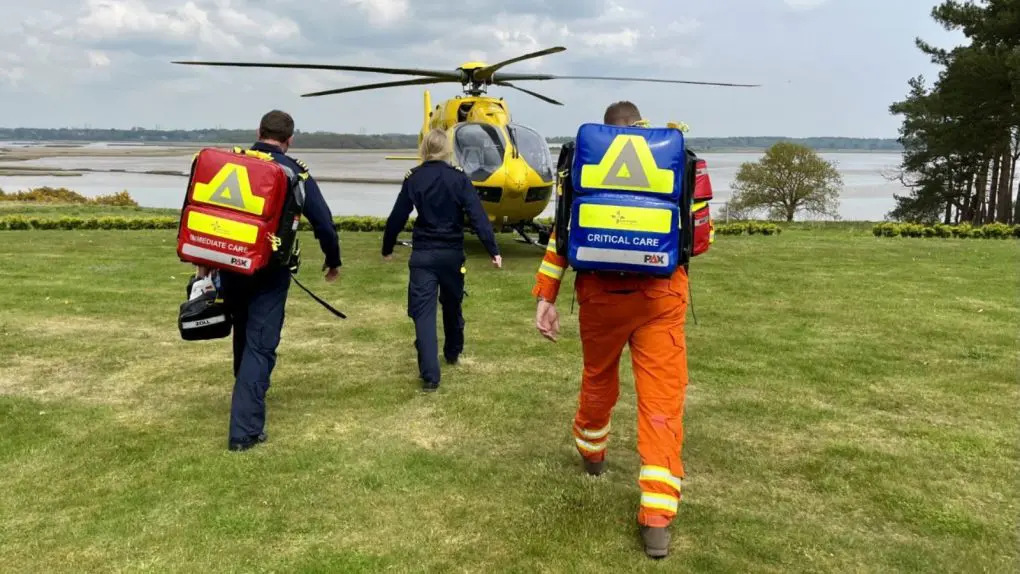
Pre-hospital emergency Medicine for healthcare professionals
Delivered by the UEA in partnership with EAAA, these modules will equip you with foundational knowledge, skills and behaviours necessary for a career in advanced PHEM.
Course overview
The Pre-Hospital Emergency Medicine (PHEM) for Healthcare Professional modules are delivered by the UEA in partnership with East Anglian Air Ambulance, ensuring a high quality, contemporary, clinically focused learning experience for practitioners working in the pre-hospital setting.
Both Pre-Hospital Emergency Medicine (PHEM) modules will equip you with foundational knowledge, skills and behaviours necessary for a career in advanced PHEM.
PHEM 1: focuses on enabling students to navigate the complexity in emergency medical systems and associated equipment and medicines management. The module covers three main topics, Working in Emergency Medical Service systems; Pre-Hospital Medicines management, Equipment and their governance; and Practical Application of Equipment and Medication in Practice.
PHEM 2: focuses on enabling students to navigate the challenges associated with austere environments, special circumstances and human factors. This module covers Assessment of the Scene and Patient in PHEM; PHEM in Special Circumstances; Human Factors in PHEM and their application.
Both modules will help to prepare students wishing to undertake the Diploma of Immediate Medical Care (DipIMC) and/or considering the Fellowship of immediate Care exam with the Royal College of Surgeons of Edinburgh.
The modules are closely aligned with the Intercollegiate Board for Training in Pre-Hospital Emergency Medicine curriculum and may be completed as a Post graduate Certificate in Specialist Practice (Pre-Hospital Emergency Medicine), when combined with the module Using Evidence to Lead and Advance Practice or form part of a MSc in Advanced Professional Practice.
Whether you are a paramedic, nurse, ODP or other registered healthcare professional this course will advance your understanding and capacity to deliver critical care in the pre-hospital environment.
Course information
- Formative Assessment: Midpoint Online Live tutorial to share a case study that will be used in summative assessment.
- Summative Assessment: Oral OSCEs for both modules.
There are no practice requirements for these modules although students will be required to reflect on their own clinical practice.
• Each 20-credit module is equivalent to 200 effort hours.
• At least one day of study per two-week block of learning.
• Attendance expected at live (synchronous) tutorials and webinars.
Each module consists of a face-to-face introductory day, a midpoint online live tutorial and a face-to-face assessment day at the end of each module. Between the face-to-face components there will be asynchronous directed learning released every two weeks. Attendance at the midpoint online live tutorials is expected.
Both modules consist of 6 blocks of learning which are released over a 12-week period. The blocks are released every two weeks and delivered online.
PHEM1 – 5 January to 25 March 2026
PHEM2 – 7 April to 7 July 2026
Pre-Hospital Emergency Medicine for Healthcare Professionals Module 1 – Systems and Resources
(Mapped against the Intercollegiate Board for Training in Pre-Hospital Emergency Medicine (IBTPHEM) Subspeciality Training in Prehospital Emergency Medicine).
By the end of this module you will be able to:
- Contrast and critique the components of differing regional, national and international models of EMS systems (1.1, 1.2, 1.9)
- Apply enhanced knowledge and understanding of the diverse and complex systems, policies, governance, and financing through which pre-hospital emergency medical patients present and are managed (1.7)
- Critically considers and apply effective communication and clinical reasoning skills in the medicines management and administration of pre-hospital medicines to individuals across the age ranges using a patient-centred approach (2.6, 2.9, 2.11)
- Critically appraise current legal, regulatory, and professional frameworks to medicines management demonstrating an awareness of ethical issues and influences on medicines management decisions (3.1, 3.5)
- Critically apply knowledge of pharmacology and epidemiology to design an appropriate evidence-based treatment plan utilising pharmacological and non-pharmacological approaches (3.5)
- Critically reflect that individuals in societies make sense of death in different ways demonstrating cultural competence, the application of legal processes relating to death, and sensitivity around death and dying (2.13)
- Critically apply the principles underlying the function and design of pre-hospital devices (3.3, 3.4)
Pre-Hospital Emergency Medicine For Healthcare Professionals Module 2 – Human Factors and Special Circumstances
By the end of this module you will be able to:
- Critically apply the concepts of major incident management in PHEM (6.1)
Evaluate the complexities associated with chemical, biological and radiological incidents in PHEM (6.4) - Critically appraise the impact of policies and procedures for Equality and Diversity within the EMS system (GPCD 3b)
- Critically reflect on the influence of human factors and ergonomics on safety (GPCD 5, B.1)
- Evaluate the importance of non-technical skills in PHEM (B.2, B.3)
Critically analyse the psychological impact of responding to special circumstances in PHEM (6.5) - Critically evaluate how practicing in an austere environment influences key concepts of enhanced assessment including history taking, examination, clinical reasoning, and the diagnostic process (2.4, 2.5)
- Critically considers and applies advanced clinical assessment and management techniques dynamically to diverse patient groups across the age ranges using a patient centred approach (2.9, 2.10, 2.11)
Although theoretically open to anyone with a professional registration with an appropriate healthcare regulatory body (HCPC, NMC, GMC) this module targets experienced qualified pre-hospital practitioners from paramedic and other AHP backgrounds as well as those from nursing backgrounds – some of whom are unable to access the GMC approved medical sub-specialty training programme in PHEM.
This level 7 module requires evidence of professional registration as a healthcare professional.
AND Evidence of academic study completed in the last 5 years as follows:
- EITHER: minimum of 2:2 at degree level previously
- OR: 55%+ in previous Level 6 module