Grae Piercy
“My memory of the accident is crystal clear. One second everything was fine, then the next, it really wasn’t."
Content warning – graphic description of incident and injury.
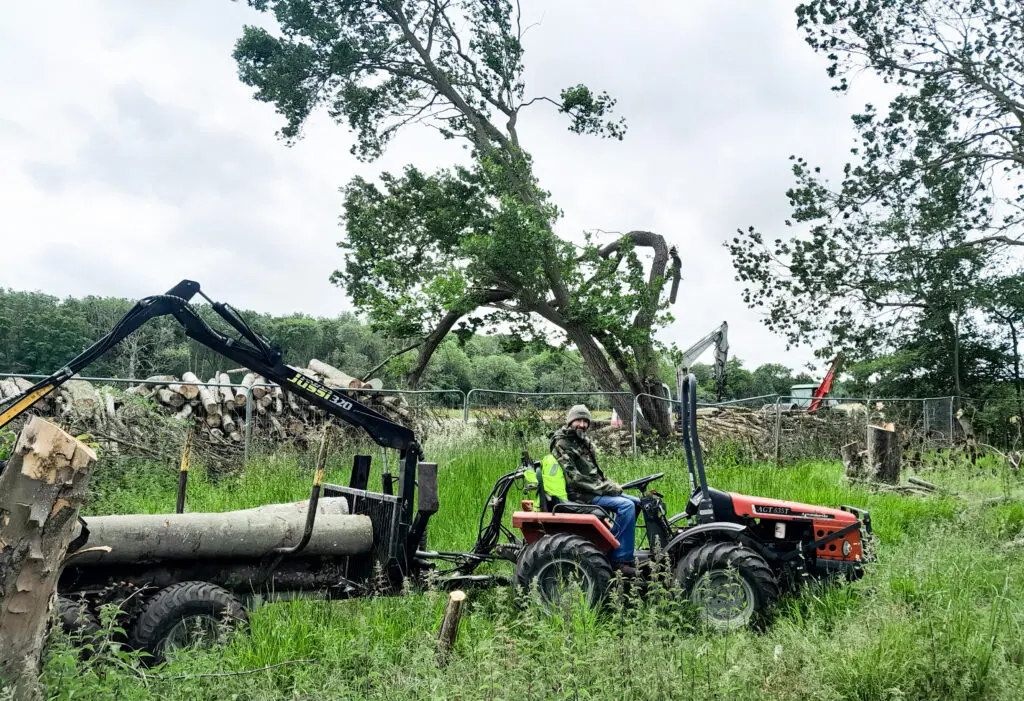
It was late afternoon on 24 March 2025. I was working in a remote woodland with my best friend and business partner, Steve, not far from Diss on the Norfolk/Suffolk border. Working in woodland management, it had been a normal day until that point. My small tractor had come back from repair the previous day and I knew I was slightly behind where I wanted to be – but that can often be the case as lots of things, such as the weather, can put me behind. However, I’m not a risk taker and I am always very safety conscious, so I was paying attention and wasn’t rushing. All was going well.
At about 5pm, I asked Steve to go ahead to his place to open his gate, ready for me to drop some timber off to him (which was on a trailer behind my car) on my way home, which he did. The plan was to make it quick and easy for me after I had finished picking up the last three logs of the day.
I continued working and used the tractor and crane to lift the logs with absolute precision – I always prided myself on getting the balance point absolutely right. I’d picked up two logs and placed them onto the trailer and, as I was driving slowly into position to pick up the third log, something smashed hard into my right leg. I think that the front wheel of the tractor had caused a piece of wood to flick up off the woodland floor and smash into my shin, which knocked my foot off the tractor foot-plate into the path of the back wheel. My leg was pulled in and underneath the tractor (which I estimate to weigh about 1.6 tons) and I realised I was having a major accident.
Everything changed and it was a fast, downward spiral.
I tried to escape, but I couldn’t. My body just crumpled as I was run over. The back wheel of the tractor ran over my right foot, my left leg, left hip and broke my pelvis in three places. It felt like it was all happening so fast, yet at the same time everything was happening in super slow motion. I could feel my bones breaking in slow motion. I had time to assess everything. I realised that I was probably going to die and I thought about my wife, Sam, our daughter, Daisy, and my friend Steve.
As the tractor crushed me, adrenaline and survival instinct kicked in. I was trapped but knew I needed to get my head out of the way of the wheel, otherwise everything would definitely be over. As the wheel ran across my left side and shoulder, I could feel my ribs exploding like a firecracker. With every ounce of strength I had, I forced my head backwards as far as I could, to move my head clear of the wheel. The tyre brushed against my cheek as the tractor rolled over me (I later learned that I ruptured discs in my neck by forcing my head out of the path of the tractor’s wheel). I knew I then needed to roll out of the way before the trailer carrying the logs, which was much heavier, reached me. My pelvis was broken, my rib cage shattered and both my collar bones broken. I had a punctured lung and was struggling to breathe. Yet somehow, I managed it and, not only that, I somehow got up, caught up with the tractor and, despite my arms not working properly, I switched off the engine.
I was critically injured and in a remote location. My phone, first aid kit and emergency procedures were kept by a nearby tree – the only spot in the woodland where there was a phone signal. Steve and I always kept this as the emergency point. If my phone had been on my person, it would have been crushed.
I just knew I had to get to my phone.
It was about 25 metres away and every step was a challenge. The pain was indescribable. I had to force myself to take each step, one at a time. It is the most challenging thing I have ever done in my whole life. I was fighting to stay conscious, but I did it and I called Steve just as I was starting to lose my vision. I told Steve that I’d had an accident. He knew it was bad when he heard my voice. He got another friend, David, to call me back to try to keep me talking while he called 999 and asked for an air ambulance. When David called, I answered but couldn’t really talk; I went into a meditative space to try to cope with the pain and remain conscious. I don’t know how much time passed.
“Can you hear all those sirens? They’re coming for you.”
These were the next words I remember hearing. Somebody came over to me; I don’t know who it was but then East Anglian Air Ambulance came. I can vaguely remember hearing the helicopter. Then I can remember Sally, a Critical Care Paramedic, and Doctors James and David, asking me what happened and where my pain was. They gave me something for the pain and I don’t really remember much after that. I have only a faint recollection of being in the helicopter, flying to hospital. I looked up and saw Sally’s face. She was wearing her flight helmet and holding my hand. She smiled and stuck her thumb up to me.
Meanwhile, my wife Sam thought it was odd that I hadn’t called to say I was going to be late home. She called me just after I’d landed at Addenbrooke’s Hospital. My pain was under control at this point, and I told her that I’d just had a ride in an air ambulance. Dr James was then able to take my phone and explain to Sam what had happened. I have no recollection of this, or anything else really of the next three days.
I was in Addenbrooke’s Hospital for 11 days before moving to the Norfolk and Norwich Hospital. I began walking again unaided that summer, but I still have a lot of upper body issues. It’s an ongoing recovery and I still have a very long way to go before I am able to go back to work. It’s been a life-changing event, both physically and mentally. It’s made me realise the value of what’s truly important and I’m a different person now. I’ve been shown that what really matters is love and kindness and to experience life – whether good or bad. I can never say or do enough to express my gratitude to everyone who helped me, including all the staff and the charity’s donors and fundraisers. It takes a lot of gears to make it all work and, as soon as I’m well enough, I want to complete my own fundraising walk to support East Anglian Air Ambulance – from the site of where I had my own accident, either to Addenbrooke’s or to the site of East Anglian Air Ambulance’s new Cambridge base.
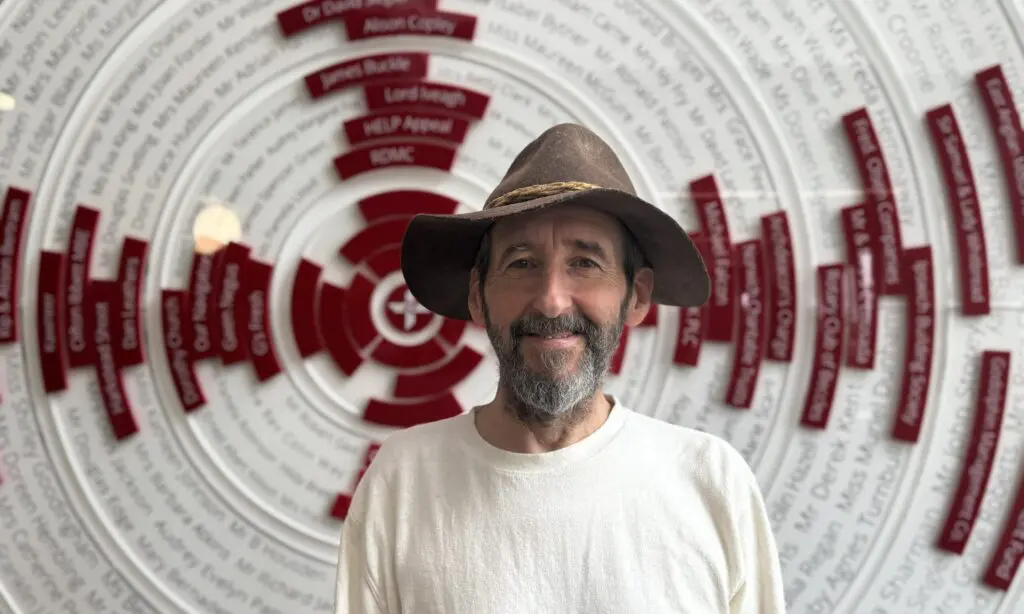
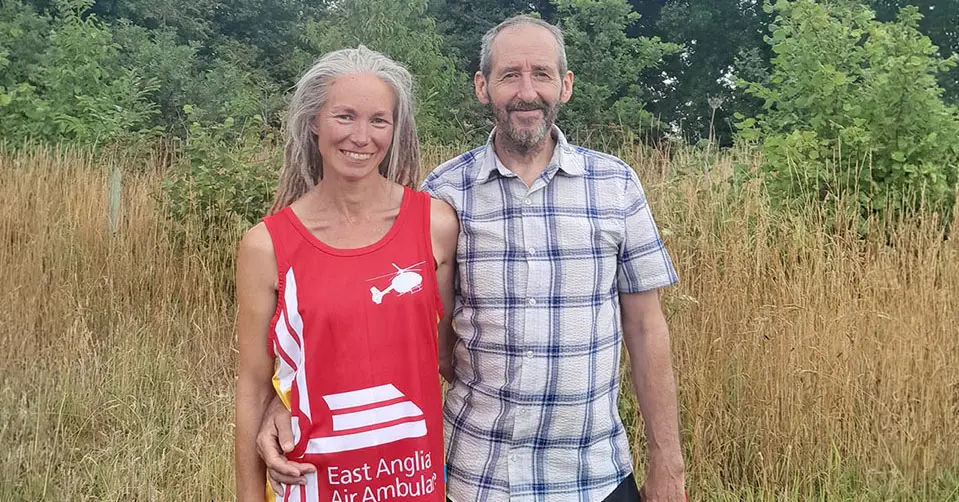
In March 2026, almost a year after my accident, Harry from the East Anglian Air Ambulance Aftercare team arranged for Sam and I to visit the Cambridge Base and meet some of the crew. This was really important to us. It was very emotional as it enabled me to meet some of people that came out to my rescue on that fateful day, and give them a big hug and thank them from the bottom of my heart for everything that they did for me.
My incident really was a freak accident in a remote location, which could happen to anyone, anytime. I did nothing wrong and the tractor didn’t break, but the accident still happened. I have so much gratitude to still be here. East Anglian Air Ambulance are amazing! They brought a highly equipped mobile hospital emergency room out to me in a remote woodland to treat me and safely transport me to Addenbrooke’s Hospital. I cannot thank them enough. Please support East Anglian Air Ambulance if you can, you never know when you might need them. Without them, myself and many other people, might not have survived to tell our story.
Following Steve’s 999 call, the Anglia Two crew, Critical Care Paramedic Sally Boor and Doctors James Price and David Clutton, from our Cambridge base were activated by helicopter at 6:02pm. They reached Grae’s side in a remote woodland just 24 minutes later. The East of England Ambulance Service, Suffolk Accident and Rescue Service and the Fire and Rescue Service were already on scene to help Grae. Our crew gave him a full assessment and administered advanced pain relief, which is over and above that carried by land ambulance crews, due to Grae’s multiple injuries. They flew him to Addenbrooke’s Hospital, our region’s major trauma centre, for specialist care.
When the very worst happens, like on the day of Grae’s accident, our crews bring intensive care directly to the scene of the incident in the fastest time possible. This service is only possible because of our two bases. However, the impending closure of Cambridge Airport – home of one of our two operating bases – threatens to cut our lifesaving service in half. With no base in Cambridgeshire, there is no East Anglian Air Ambulance crew in the centre of our region, no helicopter, and no lifesaving care. We now need to raise £8.2 million to relocate, build a new Cambridge Air Base and protect lifesaving care across the region.