Joe Lord
Just a couple of nights before Christmas in December 2022, 24-year-old Joe Lord had just been to the supermarket to do some last-minute Christmas shopping. He was driving his truck back along a country road near Thetford when he collided with a tree, leaving him critically injured.
By chance, a friend was driving along the same road shortly afterwards. Spotting an accident, they called the emergency services – but recognised the numberplate of Joe’s truck and knew it was their friend inside, injured. A crew from the ambulance service arrived on scene first and, on assessing Joe, immediately saw that he could benefit from the advanced skills, equipment and medication from a crew from East Anglian Air Ambulance. Our Anglia One (Norwich) crew, Dr Emma and Critical Care Paramedics (CCPs) Josh and Ben, were tasked to the scene by critical care car.
When they arrived, Joe was indeed in a very bad way. He had suffered head injuries and was in an agitated state. He had broken his femur, had severe injuries to his pelvis and the crew also suspected he had abdominal injuries and internal bleeding.
In the meantime, Joe’s Mum Jackie, had been contacted to say her son had been involved in a serious road accident.
“Receiving that call was a mother’s worst nightmare,” Jackie relives. “My phone rang at 8:21pm. The person on the other end asked me if I had a son called Joe. They explained he was alive – at the moment. My world just fell apart, it was horrific. I then called my other son and my daughter to let them know what had happened.”
Dr Emma and CCPs Josh and Ben assessed and began treating Joe. He was in peri-arrest, which meant he was extremely unwell and at risk of cardiac arrest. It was a critical window of time where the crew needed to work effectively and promptly together, alongside other emergency services, to give Joe the best possible care in the worst moments.
Crucially, the crew administered blood products to Joe at the roadside. Since 2021, we have been able to deliver blood transfusions as a core part of our lifesaving service. This can give the most gravely injured patients suffering a major bleed the best chance of getting to hospital through increasing oxygen delivery and clot production.
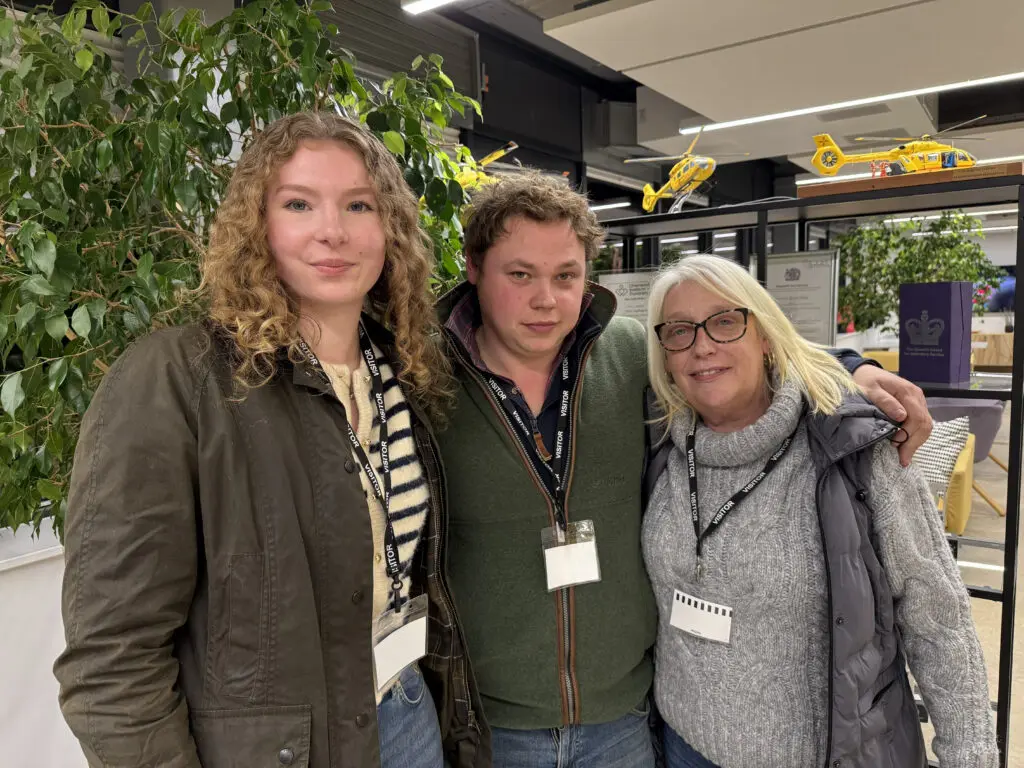
Our crew gave Joe an emergency anaesthetic at the scene so they could take over his breathing and protect his brain from further harm. They also splinted his broken femur and applied a pelvic binder to stabilise his pelvis and help slow the internal bleeding. Alongside this, they administered advanced medication to further control the bleeding – medication not normally carried by land ambulance crews. Because they were concerned Joe might need additional blood, the team decided the safest option was to transfer him by land ambulance to West Suffolk Hospital, the nearest emergency department. Meanwhile, Jackie and her eldest son made their way straight there to meet him.
“It was like being in a television programme. We arrived at hospital and sat in a side room, not knowing whether Joe was still alive. When we saw him, he was sedated with a tube down his throat,” Jackie says.
“If it wasn’t for the blood and plasma given to him at the scene, I wouldn’t have Joe now. The air ambulance doctors and paramedics were absolutely amazing. They saved my son’s life. It’s as simple as that.”
Joe was later transferred to Addenbrooke’s Hospital for further treatment and care. He was in a coma for three weeks, and in Addenbrooke’s for six weeks.
He says, “I can’t really remember any of it; all I can remember is waking up in hospital.”
Joe’s recovery has been remarkable; he started walking again earlier than expected and he returned to work the following May.
“I’m so fortunate to be talking, let alone walking,” he says.
Jackie adds, “It certainly gives you a different perspective and appreciation for people who donate blood. Without them my son wouldn’t be alive.”