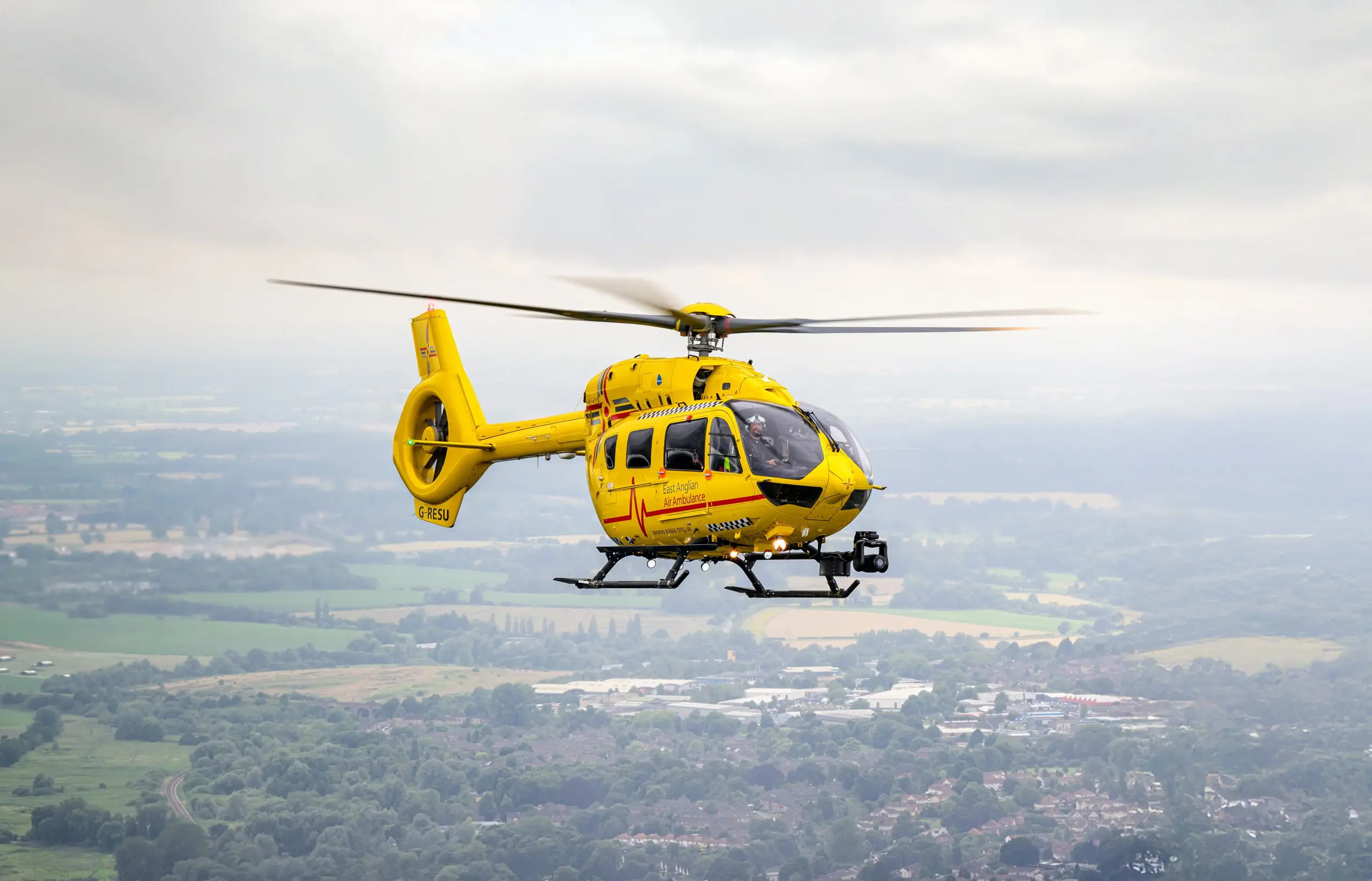
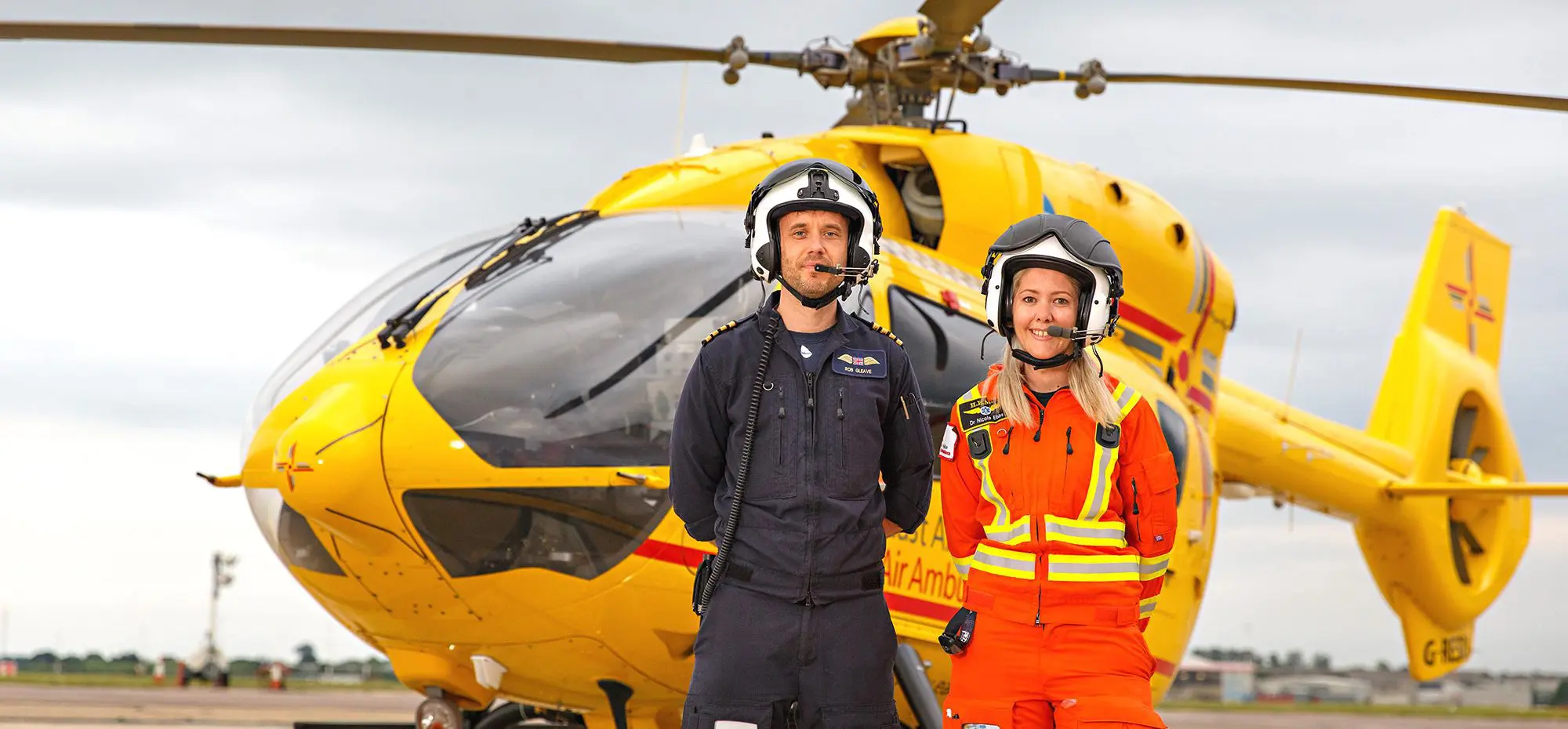
2016 was a leap year - but for us, 29 February was memorable for a very different reason. It was the day our second H145 helicopter, G-RESU, took to the skies for the very first time with East Anglian Air Ambulance.
G-RESU has become a recognisable sight in the sky above our region over the last ten years. It has been tasked 4,079 times, carrying our clinical teams to the side of 4,233 people who needed urgent, lifesaving care. While there’s no February 29 this year, we’re taking a few moments to reflect on the difference the aircraft has made to people, families and communities across East Anglia during the last decade.
A new member of the team
Our first H145 helicopter, G-HEMC, had already been in service for almost a year when G-RESU joined the charity. While G-HEMC primarily flies out of our Cambridge base, G-RESU replaced the previous EC135 as our Norwich-based aircraft. While these bases remain their usual homes, there are times when the helicopters swap location, depending on the time of year and maintenance requirements.
Our aviation partner, Babcock International Group (Babcock), provides our helicopters, pilots, and engineers. Like G-HEMC, G-RESU can carry:
- Two pilots
- Up to three clinicians
- One patient
With a cruising speed of around 140mph, G-RESU can cover 20 miles in under 10 minutes – getting critical care to the scene fast across the 5,326 square miles we serve.
G-RESU’s first task
G-RESU’s first task was on 29 February 2016 from our Norwich base to the Great Yarmouth area to take critical care directly to the side of somebody in need.
The equipment carried by our helicopters and critical care cars enables enhanced care at the incident scene – when the patient needs it most – such as blood transfusions, advanced pain relief, sedation and anaesthesia, and surgical interventions. This, combined with quick onward transfer to the most appropriate hospital, gives every patient the best possible chance of surviving and recovering a life-threatening emergency.
Just two weeks after G-RESU’s first tasking, the aircraft conveyed its first patient, accompanied by our crew, from the incident scene in Norfolk to a specialist hospital for their ongoing treatment and care.
G-RESU facts and stats*
- With 4,079 missions, the most common emergency G-RESU has been tasked to over the last decade is cardiac arrests, closely followed by 887 road accidents. The aircraft has flown over 5,000 hours.
- The top two hospitals that G-RESU has transferred patients to are the Norfolk and Norwich University Hospital, and Addenbrooke’s Hospital – which is our region’s major trauma centre.
- The aircraft’s busiest day was 11 October 2022. It was tasked six times in 24 hours, and the crew treated seven people.
- While our core counties of operation are Bedfordshire, Cambridgeshire, Norfolk and Suffolk, G-RESU can fly further afield if required. The furthest the aircraft has been tasked was in South Lincolnshire from our Norwich base. It took just 33 minutes until the crew were at the side of the patient who had been injured in a road accident.
- Common locations G-RESU has been tasked, besides Norwich, are Lowestoft and Great Yarmouth. You may have seen our pilots land on the beach in these locations.
*statistics correct to 13.01.26
In February 2022, G-RESU was upgraded to the D3 variant of the H145. Most obviously this introduced a new rotor system with five blades instead of four. Operationally it gives an increased payload, reduces vibrations and improves handling and stability, providing improved comfort for our patients and crew.
On the small screen
G-RESU is no stranger to the small screen, featuring in television documentaries including Channel 4’s ‘Emergency Helicopter Medics’ which followed several air ambulance crews, including East Anglian Air Ambulance, in the UK as they were tasked to real-life emergencies. The series provided a unique insight into the advanced skills that our crews bring directly to the side of patients, whatever their location or medical emergency.
A sustainable aviation fuel trial
In July 2024, G-RESU was one of the first air ambulance aircraft in the country to trial sustainable aviation fuel. Using a blend of 30% sustainable aviation fuel with 70% conventional Jet A1 fuel, the trial resulted in 90 minutes of flying time, covering two medical emergencies: a night tasking in West Norfolk, and a task the following day near the Norfolk/Suffolk border. While this alternative is currently more costly than traditional fuel, the expectation is that this won’t always be the case as technology and investment advances, and the benefits become more widely recognised.
More than a yellow helicopter
We’re not just a faster way to get to hospital. When every second counts, G-RESU is one of the ways we bring the expert care, specialist knowledge and lifesaving equipment, normally only found in a specialist emergency department, to the scene, whenever and wherever it is needed and the aircraft holds a special place in many people’s hearts.
In June 2018, Steve Jones had a severe motorbike accident in Norfolk. He was catapulted head-first through a brick wall into a water-filled ditch. A team from East Anglian Air Ambulance flew to the scene in G-RESU, landing just 21 minutes later.
Steve had suffered such a traumatic head injury that the medical teams knew they were battling against the odds. After ten weeks in hospital, however, he walked into a room to meet our crew who saved his life. Not only had Steve made an incredible recovery, but he even went on to finish his PhD in Software Engineering.
In 2025, Steve said, “Seeing G-RESU is always emotional, it’s just what she represents to me now.”
Lifting off, thanks to you
The H145 helicopter remains a popular platform, and there are hundreds in service across the world, both in the military and Helicopter Emergency Medical Service. G-RESU continues to serve us well and has done throughout its ten years of service with us. It’s perfectly sized with the right load and range for our region, which are just some of the reasons why it’s ideal for our lifesaving work. Thanks to your support, G-RESU and G-HEMC, are ready to respond 24/7. When someone needs us, it’s usually the worst moment of their life, and their family’s. That’s why our specialist doctors, critical care paramedics and pilots bring the advanced skills, equipment and medicine directly to the patient’s side in the fastest time possible, providing care normally only found in a specialist emergency department.
This, combined with quick onward transfer to the most appropriate hospital, gives every patient the best possible chance of surviving and recovering a life-threatening emergency. Thank you for keeping G-RESU flying for the last decade!
Related News