East Anglian Air Ambulance's BRAIN-FIRST programme shows how brain biomarker testing could be incorporated into routine pre-hospital emergency care to save more lives
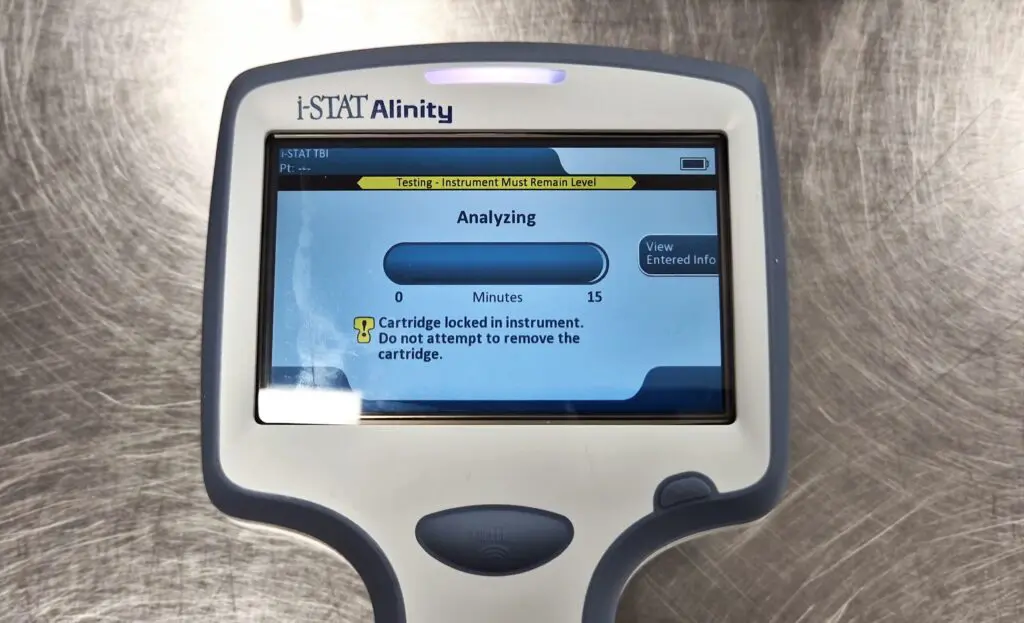
BRAIN-FIRST is a programme that enables emergency critical care teams to perform a simple blood test on patients when they reach them to rapidly measure biomarkers associated with brain injury. The test, performed with a handheld blood analyser called the iSTAT Alinity, gives doctors and paramedics biological information about the possibility of a serious brain bleed before a patient reaches hospital.
Findings from the first cohort of East Anglian Air Ambulance patients* to be treated with the analyser show that the test correctly identified every instance of an intracranial haemorrhage that occurred, without missing a single case.
Until now, doctors and paramedics have largely had to rely on a patient’s history, physical examination and clinical signs to assess the likelihood of intracranial haemorrhage. A definitive diagnosis usually requires a CT scan at a hospital. BRAIN-FIRST gives clinicians additional information while they are still at the scene, with the potential to support decisions about triage, which hospital a patient should be taken to, and how urgently specialist neuroscience care may be required.
Dr James Price, HEMS Consultant and Clinical Lead for Research and Development at East Anglian Air Ambulance, said: “BRAIN-FIRST represents a major step forward in pre-hospital emergency medicine. For the first time, we can obtain biological information about possible brain injury while we are still at the patient’s side.
Our first published results are extremely encouraging. Earlier identification of patients at high risk of a serious bleed on the brain has the potential to reduce delays to specialist treatment, avoid unnecessary secondary transfers between hospitals, and help ensure patients reach the right care, in the right place, as quickly as possible.”
The test uses the handheld i-STAT Alinity analyser, manufactured by Abbott Point of Care Inc., to measure the brain biomarkers GFAP and UCH-L1 from a small blood sample with results available in minutes. Biomarkers are measurable biological molecules found in blood, tissues or other body fluids that can provide information about normal biological processes, disease or injury. GFAP and UCH-L1 are released into the bloodstream following injury to cells within the brain.
The potential impact extends beyond earlier diagnosis. Patients with suspected intracranial haemorrhage may initially be taken to a hospital without specialist neurosurgical services before later requiring transfer to a major neuroscience centre. Earlier identification of patients at high risk could help clinicians select the most appropriate destination from the outset.
Dr Price added: “These projects would not be possible without philanthropic support. BRAIN-FIRST was made possible through the generous funding and support of Tony and Maggie Abel from Abel Homes, and we are enormously grateful for their commitment to improving care for patients with serious brain injury.”

Following initial findings, East Anglian Air Ambulance is now working with other UK and international ambulance services to expand the evaluation of BRAIN-FIRST and test the approach in a larger and more diverse patient population. In parallel, East Anglian Air Ambulance’s critical care teams are continuing to use the test and have now deployed it with more than 200 patients with suspected serious brain injury.
The charity is also developing BRAIN-FIRST2, which will investigate how brain biomarkers can be combined with clinical information to support more personalised, precision-based decision-making for patients with suspected brain injury before they reach hospital.
Further details about the initial results from the BRAIN-FIRST programme are due to be published in October in JAMA Network Open, the peer-reviewed journal of the American Medical Association.
BRAIN-FIRST has also been shortlisted for an Air Ambulances UK Award of Excellence 2026 in the Innovation of the Year category.
*The first BRAIN-FIRST study conducted by East Anglian Air Ambulance focused on 65 patients with acute non-traumatic coma, who were tested between January 2025 and April 2026.
Related News